Gorilla Trekking, Hiking the Albertine Rift, (and the pros and cons of road construction in Africa)
It’s only John and I leaving Kampala early to escape traffic on the Northern bypass. Second time in two weeks that we are heading out this way. Currently this section being built by Israeli contractors, RCC, between Masaka and Mbarara and is part of a greater plan to link inland producers of Rwanda, Burundi and DRC with the Port of Mombasa.in Kenya. All European Union funded – of course.
Sections of construction have been halted out of Masaka. As survey lines have been miscalculated by 1 metre, and residents, seeing a money making opportunity - are demanding compensation - for the 1 metre infringement into their back/front yards depending on what side of the road the are on. Not that the front / back yards have anything in them apart from sun baked, foot trodden baked red earth.
Weather had started out good but that all changes at Mbarara – heavy rain and low cloud continues for the best part of the day
Outside of Mbarara the road tender has been let to a Chinese construction company – but huge heavy machinery stands idle due to contractual disputes. Eloquently put - not a single wheel barrow has been mobilized.
An Army truck is parked on the side of the road, and solders are cutting down trees in a nearby woodland area- to go and sell to the local villages for a bit of pocket money – totally illegal of course.
A huge container truck has overturned on its side people mill around waiting to see what will happen next – lucky for them it’s not a fuel tanker with leaking fuel, as was the case in Kampala a year ago.

Very green fertile countryside – this could easily be New Zealand!!

There’s another good scam. A truck with a weighed amount of sand or stone for road construction has pulled off on the side of the road and has hurriedly dumped around ten per cent of its load. The driver then continues on and delivers the reduced amount to the road construction site. On his way back for a second load money changes hands at the dumpsite – although by now a bakkie has cleared it up and nothing can be seen.
It’s slow going in the rain. We pick up another passenger - Daniel,
No fuel in Kabale – this is serious as we are nearly empty. Eventually after driving around and much frantic calling to idle station attendants, we find one with diesel and fill up amidst a rapidly growing queue.
Kabale and Kisoro must have some of the most amazing views in the country. Stop at around 6pm at Great Lakes Coffee outside Kabale for amazing evening views. It’s a coffee growing area here; Uganda grows some of the best coffee in the world
Turn off after Kabale, head south to Rusunga (eventually - after finding the right road) for a night at Nsorangi Camp. Boda Bodas (those 50cc Chinese /Indian motorbikes that are the curse yet essential backbone of Ugandan public transport) they have given way to heavy duty Chinese bicycles with big padded carriers for carrying one, two or even three heavy duty passengers. The cyclist either peddles his passengers to their destination, or when the load is too heavy, or the going too steep he gets off and pushes them to their destination.
It’s still raining when we arrive in Rusanga town – looks ominous for the next day.
The village is set on a narrow but solid dirt road running along a ridge of a very big hill. The views are spectacular as the sun is getting low. We ask and get directions to Nsorangi Camp. We are very high up and it looks spectacular, looking out over the dense Bwindi Impenetrable Forest ahead of us. We drive a few hundred metres on and get to the turnoff to the Camp. – No vehicles are going down there – it’s too steep, and little more than a footpath. And by now the rain is persisting down. Hello Hello – no phone signal either!! We sit in the car and contemplate what to do – get soaked or wait in the growing dusk until it does subside – which isn’t going to happen soon. Just then 6 smiling cheerful faces appear in the driver’s window with umbrellas and tell us they are here to walk us down. Who needs phone when you have bush telegraph?
A quant little lodge with 4 bungalows in a beautiful garden setting. Its pumpkin soup and a choice of Spaghetti or Spaghetti for diner washed down with a couple of Tuskers. The rain is still persisting down – the rain in the bush is always a delight to hear at night but tomorrows trek is going to be a wet and muddy one!

A hidden gem - Nsorangi Camp.Rusanga
Friday (Good Friday)
Up at 6am. A quick breakfast of fruit and omelette. Low cloud and mist but the overnight rain has stopped for the moment. Check out of Nsorangi camp and it’s a stiff walk up to the car parked on the ridge and a short drive to Rusanga Gate in the south eastern part of the park. Park fees foreign residents $US300 – half price as April and May is rainy season – it certainly is – but I believe the rest of the year is actually not much better, pick our month and take our chances. This part of the country receives an annual rainfall of 26 mtrs.We.We wait around in the rain for our guides. There are five of us, John, myself Daniel and an Icelandic couple.
So while we wait - here is the deal. The park is 3fifestt, sq kms, of steep mountains and thick rain forest. Almost half of the whole world’s gorilla population live here in Bwindi, but that means onl around 34 individuals. Only 8 people are allowed to visit each habituated group of Gorillas (habituated means wild, but familiar to human contact). And there are five groups in this section of the park – more than any other section. They stick together like families, and although they move to eat, the area covered is not vast. That does not mean it is a bus tourist crowded section – on the country – the longer distance from Kampala, the rough roads in and the lesser availability of top end accommodation keeps most of the well healed away.
That suits me fine. So five groups of gorillas and eight per group – that’s 40 permits – per day - so far I’ve seen us (five) and a group of 6 Spaniards who are heading off to another gorilla group in nearby vicinity. It could be very easy to pick up last minute permits if needed. The most popular entrance to the park is Buhoma in the north where we will finish our walk on Sunday. Even without the gorillas there are 120 species of mammals of various types ( 11 primate types, elephant, and African golden cats, bush buck) are all in the forest - but the thick forest means sightings are rare.
All the trackers know where the gorilla groups are – they were mostly with them yesterday – but due to movements over the past 24 hrs they may not be in the exact spot – but won’t be too far off. The trackers have left the park HQ already and are communicating their whereabouts over two way radio. Our guides arrive with mandatory ranger and semi-automatic rifle and are assigned to each group – us and the Spaniards. They do a quick recci of our general condition, fitness, etc. and then deicide (based on yesterday’s data) how far we are capable of trekking, and hence which of the groups we will see,
Quick brief from guide – same info as above and a reassuring guarantee of fifty percent refund if we don’t find gorillas, which has never happened the guide says. Wait a minute five groups who don’t move very fast and whose whereabouts were known yesterday. I reckon if the spot is miscalculated these guys will traipse us through the thick undergrowth looking for hours , until we are the ones to say enough- in which case we have called it off, and no refund..
We head off along the boundary of park and community land – land within the park but which is allowed for human habitation. Half an hour later we turn into the Forest itself, following small path through thick undergrowth, to an estimated area based on last few days sightings. The trackers ahead are on the 2 way radios to the guides and it looks like they’ve picked up the group we are looking for. It’s still raining and very wet underfoot, slipping and sliding everywhere. We’re off the track now and the guide is slashing through the undergrowth. He shows us fresh dung and he can hear them grunting. We are sliding down, scrambling up a steep slope of thick forest in the pouring rain. An hour and a half after setting out from Rushaga we meet our group, three mature females, and one juvenile – just sitting in an area of a few square metres of flattened grass in the rain and literally only 2-3 metres away from us.
My camera lens has fogged up – lacking any serious waterproofing in this weather – frustration!! Pics not clear – can’t dry with my shirt or anything else because that is all wet too!! I’m also restricted to telephoto close ups as I’m afraid to change lenses for getting even more moisture inside the camera. Advice –to all - if nothing else- make sure you have some serious waterproof covering for your camera - something more than Nakumate carrier bags, which is all I have.
As we all take obligatory selfies, jostle cameras and lenses around, and take turns moving slowly forward toward the gorillas, then back. Meanwhile our gorillas are just sitting there and eating - and eating, and eating - nonstop eating- they do nothing else!! A big silverback, the dominant male comes into view. Click Click Click. We are only allowed 1hr with the group, and as there are 5 here the trackers have alerted us to the others a few metres away. We slide down the slope and come across 3 more huddled against the rain and still eating. More photos with steamy lens. Our guide tells us our hour is up and we head back, in very slippery conditions, following our guide on what seems. no particular route.

Big Silverback male
Gorillas in the rain
Female – non stop eating
Views of the forest through the rain
Thoroughly wet, yet thoroughly satisfied we get back to the car park and guess what - the sun comes out!! No I’m not joking – yes, blue clear skies even!!
As we head to Kissoro. We come across a fully laden truck stuck in the mud. Laden doesn’t count the 30 paying passengers sitting on top of the goods – who are now trying to pull the truck out with a rope from the front. Twenty minutes later we come across a fresh rock fall – that wasn't there 3 hours ago! All this and I’m trying to find 20 good pics - at least 20 please from the 100 odd blurred, misty or fogged up pics that were taken.
Back at Virunga backpackers in Kissoro for a hot shower, meet up with Mike and Jessica from MCU, who have just arrived from Kampala for tomorrows walk.
Uganda’s National Bird the Ugandan Crane
Easter Saturday Day 2
Next morning (Saturday) over breakfast at Virunga Backpackers we are briefed by our hiking guide for the day, Richard. It’s a two day hike but Richard is only with us today as the second we shall have Park rangers take us through Bwindi. Impenetrable Forest
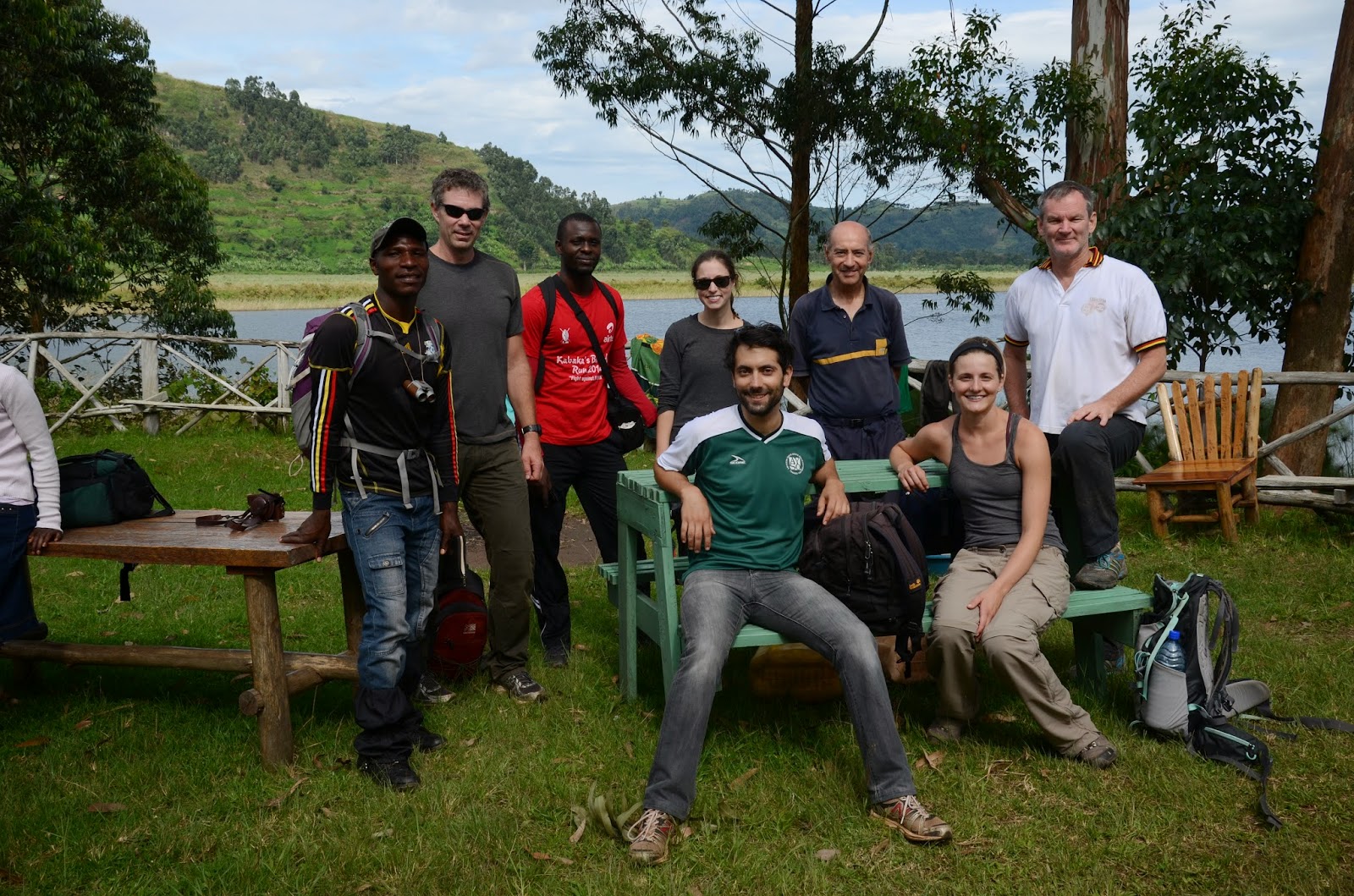
Eight of us in all Lisa (German) and Sylvian (An Italian with a serious American accent) they are both here to sell fuel (wood burning) efficient stoves (or sigili) to the locals. Jessica (Czech born Canadian raised) works with an NGO marketing local crafts then and boyfriend David, Mike an American teaching in Fort Portal, and finally John and myself.
The first hour from Kisoro will be 6 kms through local villages and communal land to Sheba’s Campsite on Lake Mutanda, then a 1hr 30 min paddle in dugout to the Rwajenge landing site on the northern shores of the lake. And then a 4 hr. walk to Bwindi Backpackers in Nkuringo village
Off we go. It’s a brisk pace; John and I are the old fogies of the group. No sun, but the clouds are high in the sky and it’s perfect for a walk. Kids everywhere. Calls of “Mzungu Mzungu” everywhere – first its “give me money”, as we are still within earshot of urban Kissoro, then further on that turns to “Mzungu give me pen”, then finally when its “Mzungu give me plastic bottle,” you know you are in the sticks and not many Mzungus have been this way.
Sheba’s Campsite and the start of canoe leg across Lake Mutanda
We reach Sheba’s campsite– and these canoes really are local log dugouts - I can hardly get my bum down into one of them, and I’m hardly fat. Two into one canoe and we have an oarsman at the back. Sylvain, Lisa and Jessica decide to do it Rambo style without an oarsman - under own steam – go for it, I say. Head out into open water and encounter a stiff breeze – our oarsman is putting his back into it. It seems hard going in the breeze and at times, looks like no going at all. We’re in the middle of the lake 400-600 metres from shore without lifejackets in very suspect hollow logs. Nothing we can really do but kick back and enjoy the scenery. It’s an awesome feeling even as the breeze picks up and every now and then a few spots of rain threaten. It’s hilarious as the three man,do it yourself team, do zigzags, 360’s and generally make a lot of noise!
Setting Out across Lake Mutanda
They provide no end of entertainment to the oarsman, who shout and laugh at each other across the water.
There are many islands in the lake, most given over to banana cultivation and subsistence farming. One island is under the administration of the National Forestry Authority where it still maintains its primary forest cover and Vervet monkeys reside.
The land area, on shore and on the islands, is dotted with small huts and communities where villagers cultivate their fields and attend to livestock. Potato cultivation is prolific in the dark volcanic soils, cabbages, green beans and peas are also grown, all done on impossibly steep gradients. The Kigezi and Kisoro districts of Uganda despite being heavily populated contribute substantially to the countries overall food production.
We make it to Rwajenge landing site with clear skies after an hour and half on the water. Bid farewell to our paddlers
Papyrus reeds are harvested from the lake here, and used as roofing material for local houses, and fencing. Women sit around in groups making baskets and the children kick around their own footballs made from the reeds.
And our walk gets serious immediately with a near 900m assent to the road on the top of ridge. From there we will walk to the road head at Rubuguri junction to join the Kisoro road –around 9 km. And a further 10 km from that junction on the Kisoro road is Nkuringo - our stop for the night - at an altitude 2160m.

Mt Virunga Mtns just after the Rwajenge landing site
After the steep walk from Rwajenge landing site we meet up with an unsurfaced road at the top, of the hill that leads up to the first rest spot with brilliant views, outside of the Mubano Trading Centre.
Kids at Mubano Trading Centre.
There is a primary school here called Kirundo with plenty of excited kids, Mzungu, Mzungu!!
Great views of Lake Mutanda, the Virunga volcanoes and the rugged ridges of the western arm of Africa's Great Rift Valley.
We stay on a village footpath and pass through banana plantations and fields of sorghum. The sorghum crop is distilled into a very popular local brew called Obushera. Obushera is real potent and consumed with great gusto by both men and women. We sample some from a local shop – its vial! Young boys carry the stuff around on the rear carriers of their bicycles in yellow 20-litre jerry cans.
Lake Mutanda, the Virunga volcanoes from Mubano Trading Centre.
We reach the road junction at Rubuguri junction, where the track we have been following joins the main murram road to Kisoro.
We are still high up. And the views along the road are just breathtaking, even better when viewed on foot. We are doing this from Kissoro – so its uphill all the way
We reach Nkuringo and the night is spent at Bwindi Backpackers. The campsite and bunkhouse sit on top of a ridge at 2160m where the north facing view looks out onto another ridge line covered in primary forest within the Bwindi Impenetrable Forest National Park. Within the forest is the round hill known as Nkuringo from where the local gorilla group takes its name. The south facing view looks towards the Virunga range and the active Nyiragongo volcano in the DR Congo can be seen in clear weather, but not today.

It’s just amazing all round!!
Bwindi Impenetrable from Backpackers Hostel Nkuringo
Beers and Tea at Bwindi Backpackers
Sunrise at Bwindi Backpackers Nkuringo
Day 3 Easter Sunday
We head of to the village of Ntungamo and to the National Parks offices at Nkuringo to pay park fees and secure the services of an armed national parks ranger and a guide to escort us to the National Parks Headquarters at Buhoma. There are two routes that can be followed although both routes meet in the forest to become one before reaching Buhoma. We are taking The Ivy River Trail. We are still high up and the views are amazing although today the Virunga Mountains are capped in cloud. But we see the distant peaks of Nyiragongo and Bukima, that extend into the Congo and are not always visible from the Ugandan side. We follow a murram road downhill through community land with amazing views over the forest for some 7 kms to the Ivy River, where we enter the real forest. There is a chance of seeing gorillas on this trip too, as we are in the Forest – but with no trackers and no recon of previous sightings there is little chance here, and our guides are keeping a steady pace and set course for Buhoma.
We reach Buhoma and are reminded of the dangers of the rebellion in the area with a memorial to English and NZ traveler’s who were attacked and killed in the area bi M23 rebels. Thanks to US military support, the Ugandan Army has largely pushed the rebels back into Congo, and taken the sting out of the scorpions’ tail. Although an on going insurgency, it has largely been contained. But the armed guard at the park HQ that comes with our park fee, is not just protection against the wildlife.
Our Driver is reunited with his family in on the drive back. We head back via Queen Elizabeth National park, as the main road dissects the park, so an added bonus of some game viewing, herds of elephant

The Virunga Massif from outside Kissoro on our way back to Kampala. The 6 Peaks. Muhabura 4127m, Garinga 3474m, Karisimbi 4507m ( highest ) Subyinyo 3614m oldest, and Mikeno 4437m. Mt Nyamuragira (active) on far right
.


