Monday, 13 July 2015

BLOG Goma and Mt Nyiragongo - Take 2 \Jan 2015


.
BLOG Goma and Mt Nyiragongo - Take 2 \Jan 2015
This time it’s with John Mooney – an MCU companion.
So us locals take a mutatu, its John first time in a local taxi and on a boda – that’s the life of an expat with company perks, the long distance mini-buses that jam in the passengers (but only as many as there are seats, including the fold-down ones running down the aisles — unlike Uganda and elsewhere, where bodies are simply jammed in any which way). For a princely fare of Rwanda Francs 2800 (about US$5) the 3-3.5 hour trip was paid for and, right on the nail, the bus left Kigali at 7am. At Gisenyi, the town on the western side of Rwanda situated right by Lake Kivu, we disembarked and found our way to the Rwanda-Congo border.
Walk across the border – the very same guy is there again outside the office at Petite Barrier, asking for health visas!!Ignore him completely!! Forms were filled in, queues were stood in (with plenty of queue-jumper attempts), various bureaucratic huffing’s and puffing’s but absolutely no hassle side. Instead, after plenty of manual transcription of every conceivable detail into a large ledger book had recorded our entry and US$50 visa fee paid.
Collect ICCU mountain climbing visas from ICCU offices at 8.30 and pay $10 for lift to Kibati in ICCU park vehicle.
I did not know at the time but no ICCU tourist visa is stamped into my passport at immigration (at the Petit Border post), 3 days later I would find out very abruptly.
Meet up with our guide at Kibati patrol post. Hire a porter. Climb steadily with several stops, with 2 Swedish guys to overnight hut – weather is overcast. Can’t resist a look at the crater, in daylight. So walk the 20 metres to the jagged crater edge. The rock cliff drops directly below us to a flat plateau 20mtrs below us and a few metres from the cliff base on the plateau the boiling lava lake sits. Clouds are swirling around the crater rim and along with a lot of crater smoke – visibility is disappointing – guide say don’t worry we come back later at night. So we head up to Crater Lake after sunset.  And yes the view is amazing. A dazzling bright red lake of slowly boiling and moving molten rock there below us. It is freezing, wind blowing hard and cold – we are wrapped up but standing stationary on any mountain will quickly cool you down. There is no heat from the lava lake 2200 mtrs below us. The cliff face below us is a sheer drop down to the plateau below and the lava lake and we are sitting right on the edge on very sharp and uncomfortable jagged volcanic rock. This would never be allowed with the over regulated first world!!
 
The 1800°F lava explodes from the lake in geysers, several every minute—25 feet high, 50 feet, bursting into arches of liquid rock morphing from orange to black in midair as they cooled. Bursts of flames light up and as quickly disappear. The lake seemed to breathe, expanding and contracting, rising and falling, its surface level changing several feet in a matter of minutes, spectacular and terrifying at once.
 
Mount Nyiragongo is an active stratovolcano with an elevation of 3470 m (11382 ft)[1] in the Virunga Mountains associated with the Albertine Rift. Nyiragongo is in the Great Rift Valley, where the African continental plate is being wrenched apart, and micro quakes constantly shake the volcano It is located inside Virunga National Park, in the Democratic Republic of the Congo, about 20 km (12 mi) north of the town of Goma and Lake Kivu and just west of the border with Rwanda. The main crater is about two kilometers wide and usually contains a lava lake. The crater presently has two distinct cooled lava benches within the crater walls - one at about 3,175 metres (10,417 ft) and a lower one at about 2,975 m (9,760 ft.). Nyiragongo lava lake has at times been the most voluminous known lava lake in recent history. The depth of the lava lake varies considerably. A maximum elevation of the lava lake was recorded at about 3,250 m (10,660 ft) prior to the January 1977 eruption - a lake depth of about 600 m (2,000 ft). A recent very low elevation of the lava lake was recorded at about 2,700 m (8,900 ft). Nyiragongo and nearby Nyamuragira are together responsible for 40% of Africa's historical volcanic eruptions. It was declared a UNESCO World Heritage site in 1979, but was labeled a site in danger in 1994 due to political conflict and poaching.
 
The night is very cold. Shelter is in two A frame donor built huts- recently rebuilt – but already showing signs of lack of up keep.
 
 
Back in Goma the roads were a black dusty mess. Signs of reconstruction and repair appeared everywhere. And the most commonly-used building material: blocks, chunks and the fine gravel all made up from lava rock. Lava rock is so widely used that many of the buildings and almost all of the walls around those buildings are coloured a dull black-grey. The UN and NGO presence is evident everywhere. Armed UN patrols, by appearance mostly Indian and Middle Eastern soldiers, are ubiquitous.
 
So at Petite Barrier crossing, the immigration officer is looking at my passport asking  me how I got into DRC – as I don’t have an entry stamp. I shrugging by shoulders at him - my Mountain permit is in the passport but no immigration stamp – rightfully so he sends me to the entry hut across the road, where I patiently explain my dilemma – and even more patiently (with John ungsting in the background) wait for the officer flips though my passport a few times and eventually stamps me into the country -  so that I can now get out.
.


Saturday, 21 February 2015

Houseboat on Lake Victoria

Houseboat on Lake Victoria
August 5th 2013
 
The Long Rains have started! 
It’s Monday morning in Kampala and there already has been quite a deluge, which now seems to have slowed down to a steady drizzle. This is great for my herb gardens. The view from my hotel room shows people in the street walking with umbrellas, brightly coloured rain jackets as well as a few motorcycles (boda boda) tootling past complete with passenger on back holding up an umbrella.
From experience so far, the rain tends to dry up after a few hours giving way to sunny skies.  The rain is so welcome; Kampala has been very dry and dusty.  So I am expecting rain each day now.


What a wonderful and different weekend we had.  Bobby and I were lucky enough to be invited to spend the weekend on a houseboat on Lake Victoria. The owners of such, Ena and Neville are farmers originally from Zimbabwe, who moved up to Uganda from South Africa where they had a game farm on the South Coast, right next to Oribi Gorge.  Sadly they suffered robberies and shootings on the farm and decided to sell up and leave.  I so admire their courage and determination. Their farm is on the banks of the lake and they are currently farming sheep as well as a very interesting fishing operation they have set up.  Apparently Neville saw his Uncle doing this on Lake Kariba and decided to give it a try in Uganda.  He seems to be doing very well and has a fleet of vessels to do the job.  These are minute fish, known as Mokweni, caught in their tons daily, then dried and sold.  They apparently have very high protein content and are tasty when cooked.  When we were on the boat, the cook fried some up in batter with chilli, the guys said they were delicious but I declined to taste, couldn’t face thinking about eating them eyes an all!


As you can see from the boat on the right, there is a circular net arrangement on the front of the boat.  (By the way the fishing is done at night).  The boats travel far out into the Lake and the fishing process begins by lowering the nets and then shining lights into the water.  The tiny Mokweni are drawn to the light and then scooped up in the net.  Each boat will collect about 7 nets per night.  From the net they are poured or rather sieved into giant plastic square bottles and stored there, salted and taken back to the farm where they get dried out on racks. Apparently they get up to 3 ½ tonnes a day


Taken from the houseboat – the Farm showing fishing racks at the front.

So now it’s about 11am Saturday morning and we are setting off on the houseboat.  Bobby and I, Ena and Neville, Sandy and Dino, Sandy’s Mom, Sue and Pete, along with skipper Jack, ex NRE, (driving us) and Peter who was the cook.  Full steam ahead and off we go – speedboat in tow for fishing excursions.


The water was very calm and what a great feeling sitting up on deck floating along on Lake Victoria, many beautiful birds to see.  Skipper Jack took us for a spin in the speedboat later on in the afternoon which was so enjoyable and we were able to spot fish eagles, pied kingfishers and small colourful finches flitting around.


Gin and tonics on deck and see the sun go down over Lake Victoria – what could be better!

Ena and Neville did us proud with the tasty food they served – finishing off with Ena’s yummy Banoffie Pie!

We slept well with the gentle rocking of the boat.  Bobby and I had a cabin downstairs which was really comfortable.

Next morning the boys went fishing and to our great delight, Pete caught really big fish!


Awesome!!

The morning was spent relaxing after our sumptuous breakfast, Bob and Pete even had a swim.


We took a slow trip back to shore, feeling so relaxed and fortunate to have spent a weekend on a houseboat – a first for Bob and I.  A really different way to spend a weekend and totally unwind.

Thanks so very much to Ena and Neville for their warm hospitality.  A highly recommended weekend getaway from Kampala city.

Neville and Ena Keith

0776674824

Ngamba Island – Jan 2012

Ngamba Island – Jan 2012
We all met at Entebbe Sailing Club by Lilly Ajaruva Executive Director of Ngamba Chimpanzee Sanctuary – board a Wild Frontiers Boat for the island with a few other day trippers.
Arrive at the island 40 mins later – get a brief by Innocent on the low down of the sanctuary.
Facts and Figures

Ngamba Island is part of the Koome group of islands located in Lake Victoria (which also includes Kiimi, Nsadzi, Koome, Bulago – which we are to vist - and Damba Islands). It is approximately 23 km south-east of Entebbe, which lies on the mainland at 0.06’S, 32.39’E. It consists of approximately 100 acres, of which 98 acres is forested and separated from the human camp by an electric fence. The northern part of the island is generally flat, rising gently to an altitude of approximately 3800 feet above sea level to the south. The island is largely forested with gaps of grassland covering approximately 10% of the island.

The northern part of the island was until 1997 inhabited by a local fishing community. The community had cleared approximately 2 acres of forest and selectively logged large trees from the more proximal parts of the forest. One acre of this area is now used as camp quarters for staff and researchers, whilst the remaining area, located between the forest and the viewing platform is where the chimpanzees are fed during the day. The chimps are rescued animals – from captivity and from injury by traps - used by hunters for bush meat  - all completely illegal.

A trail system was cut just prior to the chimpanzees’ arrival in October 1998. Trails span from east to west and north to south creating 50 x 50m blocks.

Ngamba Island provides an excellent secondary forest habitat for the chimpanzees and other wildlife species including fruit bats, spiders, fish eagles, otters, and monitor lizards.
Chimps have 97.8 % human DNA. You need inoculations against six different diseases if we are to do a forest walk, or come in contact with the chimps at all. Hepatitis A, Hepatitis B, Measles, Meningitis, Polio, Tetanus, Yellow Fever, and Seasonal Flu inoculations need to be proven. One staff member was recently taken off the island when she picked up flu.

Next day up at 6am to see a beautiful sunrise from the chimp viewing platform. We had a film crew overnight and they are off on a forest walk (inoculations all in order!)

 8 am is feeding time some of the crew have been given permission to film inside the enclosure. Innocent doesn’t seem too happy about this – it’s not allowed under normal circumstances.
   
    
The head care giver - Stanley – goes in with the crew – he has a very good report with the chimps – holding hands, carrying them on his back and hugging them – they honestly do look and behave so much like humans. But all this human contact is too much for Innocent as he would prefer them to be left as close to their natural habit as possible. This in spite of the fact that they are feed 4 times a day by humans in order to reduce the destruction of the natural forest they live in. At 8am bread, 11am fruit, 3 and 6pm is porridge. All taken so delicately and delightfully in their hands, and so human like. Innocent is very upset by the film crew’s intrusion. Meet up with Mary (management trainee from UK), Abby and Lubowa in the kitchen and have a look around at a very simple but effective kitchen – everything is run on gas or charcoal and electricity for the lodge is provided by solar panels. I’ve never seen a solar powered microwave, oven or kitchen plug points before.
                                 
After Breakfast next day, we negotiate a boat to take us over to Bulago Island where we plan to stay at Pineapple Bay. After much discussion with Patrick re how much to get there – he finally hooks up the outboard to the boat (an oversized canoe) and we head out onto the still mill pond lake, but the weather soon turns dark and we are relieved 30 mins later when we get to Bulago and ramp up onto a long sandy beach before the rain.
Old colonial style buildings in general state of dilapidation are scattered around the bay on the hill. Has an air of old time forgotten beauty? We ask the locals where the hotel is and they point to the other side of the island – it’s a short walk actually with Patrick still with us carrying our bag. Past a grass airstrip and it’s not long before we reach a batch of East African style villas right on the edge of a beautifully arced white sandy beach.
     
     
We are expected and are taken to a beautifully decorated room opening up right onto the sandy beach. The afternoon is spent at the pool with a few G+T’s, watching the abundant birdlife. We are the only 2 in the dining room that night – and feast on delicious fresh Nile perch. Old movie posters of African movie classics adorn the walls – Born Free, Casablanca, Hepburn and Bogart.  After dinner take a walk along the beach to photograph the amazing sunset.
 Jonathon arrives that evening by plane, followed close behind by Tim. Jonathon owns the hotel (bought it 2 years ago, in a very sad state of repair, from a SA couple) and Tim bought the island 10 years ago for US$10million. Bargain of the century as far as I am concerned.
                                         
We have a mini storm that night, and I am very conscious of our boat (open) ride back to Monyonyo the next day. But the morning arrives crystal clear and still as the sun comes up at 6.30am. Have breakfast on the room patio, beautiful.
Take a walk to the top of the hill to the left of the hotel. A small grave with headstone sits there dedicated to Colonial Pat Pretorius. He was the father of the original SA owners of the hotel. He had his heart in Africa but never made it back – his daughter erected this memorial to him. It must have been a difficult decision for her to sell that hotel – having virtually dedicated it to him.
Last few G+T’s around the pool before heading back to Monyonyo by hotel speed boat. The Lake is like glass. With pelicans sitting bobbing on the surface!! Beautiful!!


Sunday, 11 January 2015

The Sheraton Herb Garden

Hi, my name is Susan and I am the wife of Chef Robert – many of you will know me and have seen me working in the garden area by the Speke Steps.
When I came to Kampala to stay, which is last year September, I brought along a few packets of seeds – the idea being to  grow some herbs for use in the kitchen, especially items which could not easily be found in Kampala. 
This has been a wonderful project for me so far and a great learning experience too.  Seeing how easily seeds can pop up in this lovely warm climate and also some plants which do not want to grow!  The few herbs we started with have now increased and we now have a bigger variety and have also started another garden (behind the pool area). 
I took on the project with enthusiasm and with the assistance first of all from Jackey and now Wilson, whose help I greatly appreciate, to grow and provide, useful and interesting herbs and salad items for the Sheraton kitchen – fresh produce which we can be proud to say has been grown in our own garden and that diners can appreciate and respect.
                         
The garden teaches us many things about life.  We plant a seed – we want it to grow, so it has some requirements – we need to nurture it with good soil, water, of course sunshine (warmth), some nutrition and most important – love. We tend the garden, remove the weeds, and make sure the conditions are right so that the plants can grow.  Once we have kept them happy, they reward us with providing fresh and healthy edible leaves and roots.
Because this is an edible garden – absolutely no pesticides are used – no poisons at all – because we are eating our produce.  We are aiming to work with nature, so what we do is to plant certain flowers – for example nasturtiums and marigolds which will attract insects to them rather than to the plants, which they like to eat.  We can also spray our plants with a simple soap solution to keep certain bugs away.  This is important because once you are putting poison into the soil, it is staying there – so we rather try to work with nature –planting flowers to attract butterflies and other insects which will eat the ones which may destroy our plants.
 Of course the garden is also about change – the plants have a life span, the plants are not there for ever.  Some plants will grow and be removed for use – example spring onions, then their life is over -  some will be with us for a while longer- such as lettuce, you can pick the leaves and then they will produce new ones, until the plant has finished its life – perhaps about 6 weeks.  Other plants can last longer, such as parsley, rosemary, sage, origanium – all very flavourful herbs - are more permanent.  So it is constant change in the garden with the chance for new and varied plants.
                     
Its so rewarding to plant a small seed and see it grow into something we can take to the table, something we know is nutritious and without chemicals – indeed, organic.
                                                 

Wednesday, 15 October 2014

Gorilla Trekking, Hiking the Albertine Rift, (and the pros and cons of road construction in Africa)


 It’s only John and I leaving Kampala early to escape traffic on the Northern bypass. Second time in two weeks that we are heading out this way. Currently this section being built by Israeli contractors, RCC, between Masaka and Mbarara and is part of a greater plan to link inland producers of Rwanda, Burundi and DRC with the Port of Mombasa.in Kenya. All European Union funded – of course. Sections of construction have been halted out of Masaka. As survey lines have been miscalculated by 1 metre, and residents, seeing a money making opportunity - are demanding compensation - for the 1 metre infringement into their back/front yards depending on what side of the road the are on. Not that the front / back yards have anything in them apart from sun baked, foot trodden baked red earth. Weather had started out good but that all changes at Mbarara – heavy rain and low cloud continues for the best part of the day Outside of Mbarara the road tender has been let to a Chinese construction company – but huge heavy machinery stands idle due to contractual disputes. Eloquently put - not a single wheel barrow has been mobilized. An Army truck is parked on the side of the road, and solders are cutting down trees in a nearby woodland area- to go and sell to the local villages for a bit of pocket money – totally illegal of course. A huge container truck has overturned on its side people mill around waiting to see what will happen next – lucky for them it’s not a fuel tanker with leaking fuel, as was the case in Kampala a year ago.


Very green fertile countryside – this could easily be New Zealand!!


 There’s another good scam. A truck with a weighed amount of sand or stone for road construction has pulled off on the side of the road and has hurriedly dumped around ten per cent of its load. The driver then continues on and delivers the reduced amount to the road construction site. On his way back for a second load money changes hands at the dumpsite – although by now a bakkie has cleared it up and nothing can be seen. It’s slow going in the rain. We pick up another passenger - Daniel, No fuel in Kabale – this is serious as we are nearly empty. Eventually after driving around and much frantic calling to idle station attendants, we find one with diesel and fill up amidst a rapidly growing queue. Kabale and Kisoro must have some of the most amazing views in the country. Stop at around 6pm at Great Lakes Coffee outside Kabale for amazing evening views. It’s a coffee growing area here; Uganda grows some of the best coffee in the world Turn off after Kabale, head south to Rusunga (eventually - after finding the right road) for a night at Nsorangi Camp. Boda Bodas (those 50cc Chinese /Indian motorbikes that are the curse yet essential backbone of Ugandan public transport) they have given way to heavy duty Chinese bicycles with big padded carriers for carrying one, two or even three heavy duty passengers. The cyclist either peddles his passengers to their destination, or when the load is too heavy, or the going too steep he gets off and pushes them to their destination. It’s still raining when we arrive in Rusanga town – looks ominous for the next day. The village is set on a narrow but solid dirt road running along a ridge of a very big hill. The views are spectacular as the sun is getting low. We ask and get directions to Nsorangi Camp. We are very high up and it looks spectacular, looking out over the dense Bwindi Impenetrable Forest ahead of us. We drive a few hundred metres on and get to the turnoff to the Camp. – No vehicles are going down there – it’s too steep, and little more than a footpath. And by now the rain is persisting down. Hello Hello – no phone signal either!! We sit in the car and contemplate what to do – get soaked or wait in the growing dusk until it does subside – which isn’t going to happen soon. Just then 6 smiling cheerful faces appear in the driver’s window with umbrellas and tell us they are here to walk us down. Who needs phone when you have bush telegraph? A quant little lodge with 4 bungalows in a beautiful garden setting. Its pumpkin soup and a choice of Spaghetti or Spaghetti for diner washed down with a couple of Tuskers. The rain is still persisting down – the rain in the bush is always a delight to hear at night but tomorrows trek is going to be a wet and muddy one!


 A hidden gem - Nsorangi Camp.Rusanga

 Friday (Good Friday) 

Up at 6am. A quick breakfast of fruit and omelette. Low cloud and mist but the overnight rain has stopped for the moment. Check out of Nsorangi camp and it’s a stiff walk up to the car parked on the ridge and a short drive to Rusanga Gate in the south eastern part of the park. Park fees foreign residents $US300 – half price as April and May is rainy season – it certainly is – but I believe the rest of the year is actually not much better, pick our month and take our chances. This part of the country receives an annual rainfall of 26 mtrs.We.We wait around in the rain for our guides. There are five of us, John, myself Daniel and an Icelandic couple. So while we wait - here is the deal. The park is 3fifestt, sq kms, of steep mountains and thick rain forest. Almost half of the whole world’s gorilla population live here in Bwindi, but that means onl around 34 individuals. Only 8 people are allowed to visit each habituated group of Gorillas (habituated means wild, but familiar to human contact). And there are five groups in this section of the park – more than any other section. They stick together like families, and although they move to eat, the area covered is not vast. That does not mean it is a bus tourist crowded section – on the country – the longer distance from Kampala, the rough roads in and the lesser availability of top end accommodation keeps most of the well healed away. That suits me fine. So five groups of gorillas and eight per group – that’s 40 permits – per day - so far I’ve seen us (five) and a group of 6 Spaniards who are heading off to another gorilla group in nearby vicinity. It could be very easy to pick up last minute permits if needed. The most popular entrance to the park is Buhoma in the north where we will finish our walk on Sunday. Even without the gorillas there are 120 species of mammals of various types ( 11 primate types, elephant, and African golden cats, bush buck) are all in the forest - but the thick forest means sightings are rare. All the trackers know where the gorilla groups are – they were mostly with them yesterday – but due to movements over the past 24 hrs they may not be in the exact spot – but won’t be too far off. The trackers have left the park HQ already and are communicating their whereabouts over two way radio. Our guides arrive with mandatory ranger and semi-automatic rifle and are assigned to each group – us and the Spaniards. They do a quick recci of our general condition, fitness, etc. and then deicide (based on yesterday’s data) how far we are capable of trekking, and hence which of the groups we will see, Quick brief from guide – same info as above and a reassuring guarantee of fifty percent refund if we don’t find gorillas, which has never happened the guide says. Wait a minute five groups who don’t move very fast and whose whereabouts were known yesterday. I reckon if the spot is miscalculated these guys will traipse us through the thick undergrowth looking for hours , until we are the ones to say enough- in which case we have called it off, and no refund.. We head off along the boundary of park and community land – land within the park but which is allowed for human habitation. Half an hour later we turn into the Forest itself, following small path through thick undergrowth, to an estimated area based on last few days sightings. The trackers ahead are on the 2 way radios to the guides and it looks like they’ve picked up the group we are looking for. It’s still raining and very wet underfoot, slipping and sliding everywhere. We’re off the track now and the guide is slashing through the undergrowth. He shows us fresh dung and he can hear them grunting. We are sliding down, scrambling up a steep slope of thick forest in the pouring rain. An hour and a half after setting out from Rushaga we meet our group, three mature females, and one juvenile – just sitting in an area of a few square metres of flattened grass in the rain and literally only 2-3 metres away from us. My camera lens has fogged up – lacking any serious waterproofing in this weather – frustration!! Pics not clear – can’t dry with my shirt or anything else because that is all wet too!! I’m also restricted to telephoto close ups as I’m afraid to change lenses for getting even more moisture inside the camera. Advice –to all - if nothing else- make sure you have some serious waterproof covering for your camera - something more than Nakumate carrier bags, which is all I have. As we all take obligatory selfies, jostle cameras and lenses around, and take turns moving slowly forward toward the gorillas, then back. Meanwhile our gorillas are just sitting there and eating - and eating, and eating - nonstop eating- they do nothing else!! A big silverback, the dominant male comes into view. Click Click Click. We are only allowed 1hr with the group, and as there are 5 here the trackers have alerted us to the others a few metres away. We slide down the slope and come across 3 more huddled against the rain and still eating. More photos with steamy lens. Our guide tells us our hour is up and we head back, in very slippery conditions, following our guide on what seems. no particular route.


 Big Silverback male


 Gorillas in the rain


 Female – non stop eating


Views of the forest through the rain

 Thoroughly wet, yet thoroughly satisfied we get back to the car park and guess what - the sun comes out!! No I’m not joking – yes, blue clear skies even!! As we head to Kissoro. We come across a fully laden truck stuck in the mud. Laden doesn’t count the 30 paying passengers sitting on top of the goods – who are now trying to pull the truck out with a rope from the front. Twenty minutes later we come across a fresh rock fall – that wasn't there 3 hours ago! All this and I’m trying to find 20 good pics - at least 20 please from the 100 odd blurred, misty or fogged up pics that were taken. Back at Virunga backpackers in Kissoro for a hot shower, meet up with Mike and Jessica from MCU, who have just arrived from Kampala for tomorrows walk.


 Uganda’s National Bird the Ugandan Crane

 Easter Saturday Day 2
Next morning (Saturday) over breakfast at Virunga Backpackers we are briefed by our hiking guide for the day, Richard. It’s a two day hike but Richard is only with us today as the second we shall have Park rangers take us through Bwindi. Impenetrable Forest Eight of us in all Lisa (German) and Sylvian (An Italian with a serious American accent) they are both here to sell fuel (wood burning) efficient stoves (or sigili) to the locals. Jessica (Czech born Canadian raised) works with an NGO marketing local crafts then and boyfriend David, Mike an American teaching in Fort Portal, and finally John and myself. The first hour from Kisoro will be 6 kms through local villages and communal land to Sheba’s Campsite on Lake Mutanda, then a 1hr 30 min paddle in dugout to the Rwajenge landing site on the northern shores of the lake. And then a 4 hr. walk to Bwindi Backpackers in Nkuringo village Off we go. It’s a brisk pace; John and I are the old fogies of the group. No sun, but the clouds are high in the sky and it’s perfect for a walk. Kids everywhere. Calls of “Mzungu Mzungu” everywhere – first its “give me money”, as we are still within earshot of urban Kissoro, then further on that turns to “Mzungu give me pen”, then finally when its “Mzungu give me plastic bottle,” you know you are in the sticks and not many Mzungus have been this way.
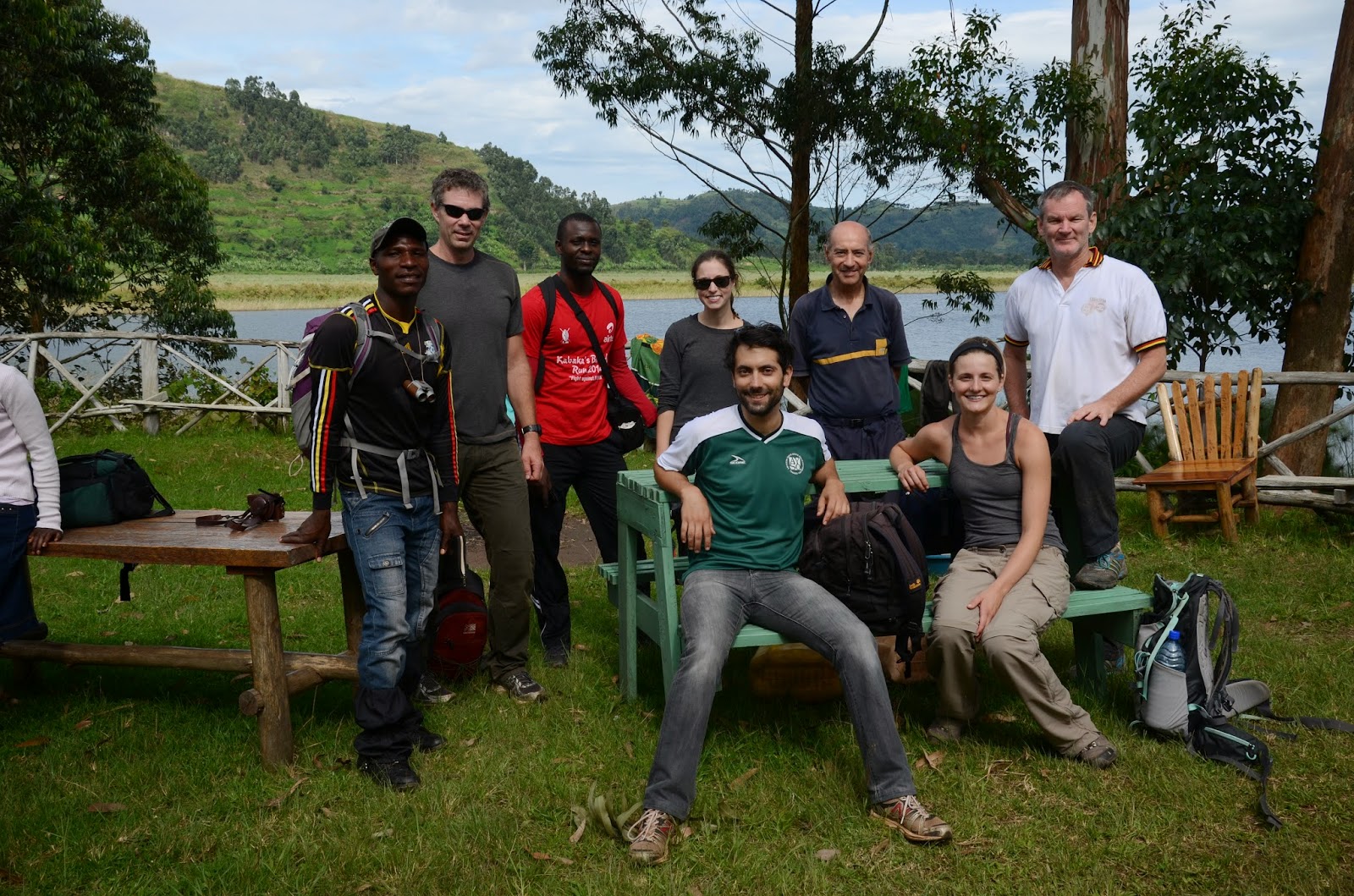

 Sheba’s Campsite and the start of canoe leg across Lake Mutanda

 We  reach Sheba’s campsite– and these canoes really are local log dugouts - I can hardly get my bum down into one of them, and I’m hardly fat. Two into one canoe and we have an oarsman at the back. Sylvain, Lisa  and Jessica decide to do it Rambo style without an oarsman - under own steam – go for it, I say. Head out into open water and encounter a stiff breeze – our oarsman is putting his back into it. It seems hard going in the breeze and at times, looks like no going at all. We’re in the middle of the lake 400-600 metres from shore without lifejackets in very suspect hollow logs. Nothing we can really do but kick back and enjoy the scenery. It’s an awesome feeling even as the breeze picks up and every now and then a few spots of rain threaten. It’s hilarious as the three man,do it yourself team, do zigzags, 360’s and generally make a lot of noise!

 Setting Out across Lake Mutanda

 They provide no end of entertainment to the oarsman, who shout and laugh at each other across the water. There are many islands in the lake, most given over to banana cultivation and subsistence farming. One island is under the administration of the National Forestry Authority where it still maintains its primary forest cover and Vervet monkeys reside. The land area, on shore and on the islands, is dotted with small huts and communities where villagers cultivate their fields and attend to livestock. Potato cultivation is prolific in the dark volcanic soils, cabbages, green beans and peas are also grown, all done on impossibly steep gradients. The Kigezi and Kisoro districts of Uganda despite being heavily populated contribute substantially to the countries overall food production. We make it to Rwajenge landing site with clear skies after an hour and half on the water. Bid farewell to our paddlers Papyrus reeds are harvested from the lake here, and used as roofing material for local houses, and fencing. Women sit around in groups making baskets and the children kick around their own footballs made from the reeds. And our walk gets serious immediately with a near 900m assent to the road on the top of ridge. From there we will walk to the road head at Rubuguri junction to join the Kisoro road –around 9 km. And a further 10 km from that junction on the Kisoro road is Nkuringo - our stop for the night - at an altitude 2160m.

 Mt Virunga Mtns just after the Rwajenge landing site

 After the steep walk from Rwajenge landing site we meet up with an unsurfaced road at the top, of the hill that leads up to the first rest spot with brilliant views, outside of the Mubano Trading Centre.

 Kids at Mubano Trading Centre.
There is a primary school here called Kirundo with plenty of excited kids, Mzungu, Mzungu!!


Great views of Lake Mutanda, the Virunga volcanoes and the rugged ridges of the western arm of Africa's Great Rift Valley.

We stay on a village footpath and pass through banana plantations and fields of sorghum. The sorghum crop is distilled into a very popular local brew called Obushera. Obushera is real potent and consumed with great gusto by both men and women. We sample some from a local shop – its vial! Young boys carry the stuff around on the rear carriers of their bicycles in yellow 20-litre jerry cans. Lake Mutanda, the Virunga volcanoes from Mubano Trading Centre. We reach the road junction at Rubuguri junction, where the track we have been following joins the main murram road to Kisoro. We are still high up. And the views along the road are just breathtaking, even better when viewed on foot. We are doing this from Kissoro – so its uphill all the way We reach Nkuringo and the night is spent at Bwindi Backpackers. The campsite and bunkhouse sit on top of a ridge at 2160m where the north facing view looks out onto another ridge line covered in primary forest within the Bwindi Impenetrable Forest National Park. Within the forest is the round hill known as Nkuringo from where the local gorilla group takes its name. The south facing view looks towards the Virunga range and the active Nyiragongo volcano in the DR Congo can be seen in clear weather, but not today.

 It’s just amazing all round!! Bwindi Impenetrable from Backpackers Hostel Nkuringo


 Beers and Tea at Bwindi Backpackers


 Sunrise at Bwindi Backpackers Nkuringo

 Day 3 Easter Sunday 
 We head of to the village of Ntungamo and to the National Parks offices at Nkuringo to pay park fees and secure the services of an armed national parks ranger and a guide to escort us to the National Parks Headquarters at Buhoma. There are two routes that can be followed although both routes meet in the forest to become one before reaching Buhoma. We are taking The Ivy River Trail. We are still high up and the views are amazing although today the Virunga Mountains are capped in cloud. But we see the distant peaks of Nyiragongo and Bukima, that extend into the Congo and are not always visible from the Ugandan side. We follow a murram road downhill through community land with amazing views over the forest for some 7 kms to the Ivy River, where we enter the real forest. There is a chance of seeing gorillas on this trip too, as we are in the Forest – but with no trackers and no recon of previous sightings there is little chance here, and our guides are keeping a steady pace and set course for Buhoma. We reach Buhoma and are reminded of the dangers of the rebellion in the area with a memorial to English and NZ traveler’s who were attacked and killed in the area bi M23 rebels. Thanks to US military support, the Ugandan Army has largely pushed the rebels back into Congo, and taken the sting out of the scorpions’ tail. Although an on going insurgency, it has largely been contained. But the armed guard at the park HQ that comes with our park fee, is not just protection against the wildlife. Our Driver is reunited with his family in on the drive back. We head back via Queen Elizabeth National park, as the main road dissects the park, so an added bonus of some game viewing, herds of elephant


  The Virunga Massif from outside Kissoro on our way back to Kampala. The 6 Peaks. Muhabura 4127m, Garinga 3474m, Karisimbi 4507m ( highest ) Subyinyo 3614m oldest, and Mikeno 4437m. Mt Nyamuragira (active) on far right .

Tuesday, 1 October 2013

Letter from Kampala

Letter from Kampala

Hi all 15 / 8 / 2013 Well there is nothing like 13 hrs in a plane to provide a bit of really needed downtime. A badly needed mail to friends and family worldwide. On my way to Casablanca at short notice as is most things these days - (with Sue ) – to our sister hotel in Morocco to stand in over a 6 week busy period between departing and arriving Exec Chefs. Was there last year chasing our elusive Ethiopian Sheik ( Al Amoudi– our group owner ) - who actually never arrived, but I must have built up a bit of staff loyalty then – despite my minimal French – as they (the staff ) asked me back when it became apparent the newly arrived Italian chef wasn’t cracking it. Flying via Dubai from Entebbe with a comp hotel room - as the layover is longer than 8hrs – these guys know how to look after you!!! Oh and BTW flying Business class!! Thanks to good connections back in Kampala!! I have flown a lot over the years but this is the first time ever in Business class. Bollinger Champas on tap and loads of leg room!! Have just finished a big Vintage Car Day carnival at the Sheraton the day before – a couple of beautiful looking old cars lovingly cared for – think I recognized an old Austin minor ( or what was it Dad ) -from a few of your old photos Mum / Dad. Always a pile of VW beetles turn up – don’t really know how they can be vintage even if they are 50 yrs old. The day has grown into a fun filled carnaival day over the years and this year was no exception, but anything off the premises is always bloody hard work. Second lying leg now and the business class connection doesn’t extend this far, so it’s back to economy – and after 20 min Sues decided I had better earn enough money to book her business class from now on.!! Don’t think that will ever happen!! We seem to be taking a big detour and exiting the African continent at Alexander and doing a loop across the top of Libya and Tunisia. But we’ve just flown straight over Cairo, without seeing any missiles?? Actually very nearly booked the ticket for Sue on Air Egypt to avoid the long wait in Dubai – until they told me that there is a good chance that the plane would be diverted, if the strife there continues. Sue has just noticed that the Bols we had in Business the day before, sells in econ for US$15/glass, good thing we made the most of it. The past few months have had their fair share of pleasure and strife. Had a brill week end on a houseboat on lake Victoria (Lake Kariba, in Zim style – built by a pioneering Zimbo of course ) Fishing, bird watching and general relaxation ( see blog for story ). We’ve bought ourselves a car which provides us with freedom of movement and has made life a lot easier – As sue will not put her life in the hands of the boda bodas ( 50cc Chinese motorcycle riders who provide the backbone of public transportation around the city ) An old Toyota Rav 4 Japanese 2nd hand import. They say 1998 with 68000kms on the clock – I say whatever. Seems to go OK but we need take it on a long African trip, to trash it a bit on the African dirt roads to see how it holds up. Had a great beginning to the year with a trip to Zanzibar – beautiful. Details on Blog. Then it was back to a freezing SA over Easter. (I forgotten how cold Jhb is in winter) Went to Dubai in March to attend the biggest hospitality trade show on the planet. Thousands of exhibiter’s, food equipment and services. Bought up equipment for the seafood restaurant and most importantly tied up a few fresh seafood suppliers for us. Great to meet up with a couple of colleagues – one whom has landed himself a great job as hospitality industry adviser for Fonterra, based in Dubai SuDid a bit of house sitting for SA friends who have gone back to SA for a couple of weeks. Good to be out of the hotel and in a garden and the outdoors etc. A typical expatriate house, massive, very colonial, with staff, guards etc!! For only 2 people - most of the expat housing here is v big. Work is a challenge as usual; staffing and an inconsonant supply of essential stocks are a never ending source of frustration. Had a few foreign donor and NGO related scandals here recently (in fact permanently ongoing scandals), funds from donors finding their way into African politicians’ pockets? Why are they (the donors) sooo surprised when their money ends up in a politicians pocket – hello this is Africa after all – it’s not like you donors haven’t had years to learn from???!!! Anyway as a result, donor and foreign aid related conferences and training has dropped of, so business at the hotel has been affected. But no doubt the guilt ridden European mindset will get back on track soon - ie, that our poor troubled African brothers need our help and that we owe it to them - God knows why we owe it to them. And the lucrative handout business will soon get back on track soon! Had a great visit from Morgan a few weeks ago – went to Lake Imburo for a couple of days 4 hrs south west of Kampala. A great few days with brilliant weather (as usual) Highlight of the weekend was spotting two leopards in one night drive. Were told that the ranger who came out with us was an expert – and he certainly was – 2 within 20 mins of each other. First young one sat around us for a while providing perfect photo opps, while the second more mature adult was on a mission and not at all interested in entertaining us. Beautiful scenery and wildlife once again as usual. But not cheap if you need comfort (as my wife does these days )!! Pics to Follow and Sue’s story!! Shane an ex-kiwi from SA came up for a while and went on to see the migration in Masi Mara. Was good to get out and around a bit with a fellow back packer. What a great game the super 15 final – and the Wimbledon tennis with Andy Murrey winning easily. Oh Boy – what drama with Fonterra. All over the news – but seems to have been contained but the proof will be told long term – this sort of thing can break a multinational. Actually meet up in Dubai with an old mate now in Dubai working on marketing Fonterra to the hotel and Catering business- that’s the sort of job I want – too old now for this kitchen lark!! NZ earthquakes keep popping up on the international networks, recent being Friday last week. How’s the feeling? We actually had a big tremor here a few weeks ago – quiet scary 12 storeys up a hotel – shook in the middle of the night and woke most of us up and sent some scared guests into the lobby in their nighties !! First one I’ve felt for a long time – as we don’t experience them in SA. Heard that Zinzan Brooke was coming in Oct – doing a fund raiser here - for whom - don’t know. Saw Valarie Adams in the Moscow Athletics Grand Prix shot putt event – great news after the mess up she endured getting to the Olympics. Signing off. As I’m sure it will be balls to the wall as soon as we arrive in Skhirat - 20mins south of Rabat. Beautiful spot on a remote part of the coast. Google it L Amphitrite palace Skhirat On arrival back in Kampala hopefully the long awaited seafood restaurant will be ready for opening! Will try and get another mail away maybe on the way back. Been here a week - yes balls to the wall. 3 hr notice for a 200 pax functions – the sheiks private plane pulls in with catering order of foie gras, lobster and others - enough to feed 50. A kitchen brigade badly in need of motivation, and checking me out. But a beautiful turquoise sea and blue Moroccan skies. As they say in Yorkshire – Ah!! It’s a grand life if you don’t weaken!!